Top / 04 Power
The dynamic between two mausoleums
A few minutes' walk from Toshogu stands Taiyuin, the mausoleum of the third shogun, Tokugawa Iemitsu. It's meant to be more restrained than Toshogu — and yet many visitors come away saying the opposite. Here's why, followed by an even bigger unresolved question about Toshogu itself: is Ieyasu's body actually here?
Taiyuin
Iemitsu is said to have left instructions before his death that his own mausoleum should be more modest than Toshogu's — that it must never outshine his grandfather's authority. Completed in 1653, Taiyuin is indeed somewhat smaller than Toshogu, with fewer structures and a more restrained layout overall.
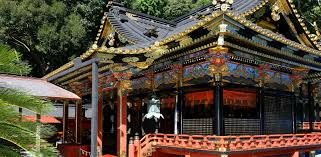
And yet walking through it tells a different story. A sequence of gates climbs the hillside in stages, from the Niomon Gate to the Kokamon Gate. Kano Tan'yu's painted lions decorate the sliding doors. The ceiling holds 140 individual dragon paintings. The fence surrounding the worship and main halls is dense with the Tokugawa hollyhock crest. Many visitors, expecting restraint, instead come away calling it the more lavish of the two.
White and gold as its base palette. Vivid, multicolored carvings applied without restraint — architecture built to project power and vitality, the "yang" register.
Black lacquer layered with gold — an aesthetic of "yin." With fewer structures overall, each individual decoration carries more visual density and weight.
The instruction to stay within scale was honored — but the choice of color and density created a different kind of opulence entirely. That's the most interesting thing about Taiyuin. Its main hall is also said to be oriented to face Toshogu, a detail some read as embedding, in the very architecture, a grandson's role of guarding his grandfather even in death.
An unresolved debate
Climb more than 200 stone steps to the deepest point of Toshogu and you'll reach the Inner Shrine, where a stone pagoda is said to hold the remains of Tokugawa Ieyasu. Most guides state this as fact — but Kunozan Toshogu in Shizuoka has long disputed it.
Ieyasu is said to have left these instructions shortly before his death: bury my body at Kunozan, hold my funeral at Zojoji Temple, enshrine my memorial tablet at Daijuji Temple, and after one year has passed, build a small shrine at Nikko and perform kanjo there. Kanjo means dividing and inviting a deity's spirit to a new location — distinct from moving physical remains. Read literally, this instruction suggests the body stayed at Kunozan, and only Ieyasu's divided spirit was enshrined at Nikko.
Kunozan's side often points to one piece of supporting evidence: on Ieyasu's death anniversary (April 17), the head of the Tokugawa main family visits only Kunozan Toshogu, never the Inner Shrine at Nikko. Naturally, Nikko Toshogu maintains that the Inner Shrine is indeed where Ieyasu rests. Neither side has produced conclusive physical proof. Four hundred years on, the final resting place of the man who unified Japan is still not fully settled — another detail you won't find in most tourist brochures.
Next: the Meiji-era foreigners who fell for Nikko →