Top / 01 Design
Code hidden in the carvings
The Yomeimon Gate, the Sleeping Cat, the Three Wise Monkeys — Nikko Toshogu's highlights get reduced to photogenic snapshots. Most of them are fragments of a longer story, or a deliberate trick. This page slows down on the parts a tour guide rushes past in a few seconds.
The Sacred Stable
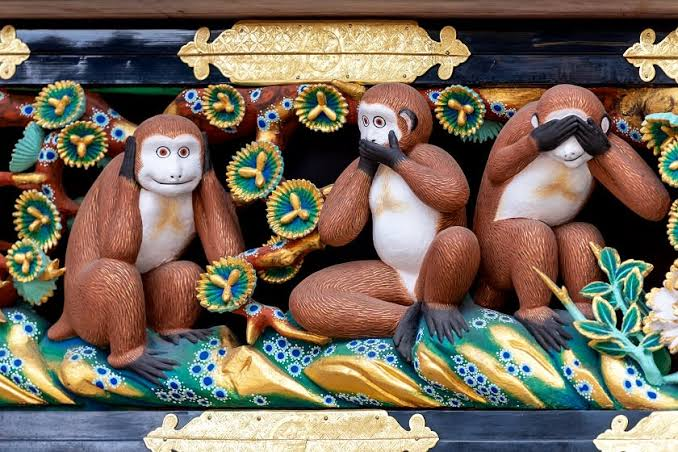
"See no evil, hear no evil, speak no evil" — the famous Three Wise Monkeys are the second of eight relief carvings on the eaves of the Shinkyusha, the stable built for the shrine's sacred horse. Across those eight panels, the building tells a single continuous story: one monkey's life, from birth to raising the next generation.
① Birth — A mother monkey shades her eyes, gazing into her child's future.
② Childhood (the Three Monkeys) — Don't look at, listen to, or speak of bad things.
③ Independence — A lone monkey sits by itself, the age of leaving one's parents.
④ Ambition — Two monkeys look up at the sky, toward the future.
⑤ Setback — A dejected monkey is comforted by two others at its sides.
⑥ Love — Two monkeys lost in thought.
⑦ Marriage — A pair sets off together into a new life.
⑧ The next generation — A pregnant mother monkey appears, and the story loops back to ①.
So the Three Wise Monkeys are both a lesson in child-rearing — shield children from bad influences — and the opening act of a much longer satire on a human life. Most visitors stop only at the three monkeys and walk right past the other seven panels.
Monkeys were chosen for the stable because folk belief long held them to be protectors of horses. No other building is known to carve an entire monkey's life story onto a stable — a distinctly Nikko touch.
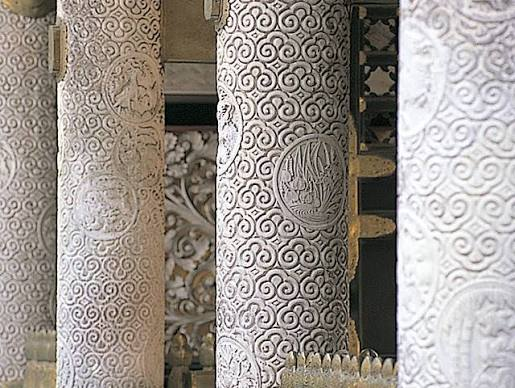
The Yomeimon Gate
All twelve pillars of the Yomeimon Gate are carved with a spiral pattern called guri-mon. Look closely, though, and one of them is carved upside down. It sits at the north (rear) side, just past the gate, the second pillar from the west. This is officially explained not as an error, but as a deliberate act of protection against misfortune.
The idea comes from an old belief: "once something is complete, it can only decay." By leaving one detail intentionally "unfinished," the builders hoped to stave off the structure's decline — an apotropaic logic grounded in imperfection by design.
What makes it even more interesting: for a long time this was described as the only inverted pillar. But a 1987 survey found two more among the sixteen pillars separating the worship hall, the stone chamber, and the main hall. In total, three inverted pillars are now confirmed — a deliberate "flaw" planted by Edo-period craftsmen that took 350 years of inspection to be fully uncovered.
The Sleeping Cat
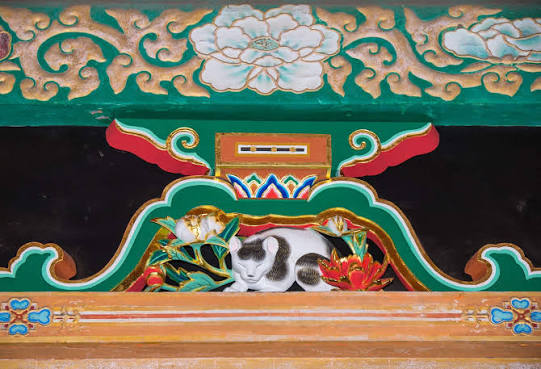
Just before the gate leading up to the Inner Shrine, a small transom holds one of Toshogu's most beloved carvings: the Sleeping Cat. Few visitors realize that on its reverse side — invisible from the front — two sparrows are carved.
A cat is a natural predator of sparrows. Here, that predator sleeps soundly while its prey rests undisturbed nearby. One widely shared interpretation reads this as a symbol of an era so peaceful that "even the cat can doze off" — a declaration, in carved wood, that the age of civil war was truly over.
Tradition attributes the work to the legendary early-Edo sculptor Hidari Jingoro, but there is no solid documentary evidence for this. In fact, whether Hidari Jingoro himself ever existed at all is uncertain — his reputation seems to have been built up through later storytelling. A legendary master's supposed work, resting on a legend about the master himself: a neat little nesting doll of folklore.
Honjido (Yakushido) Hall
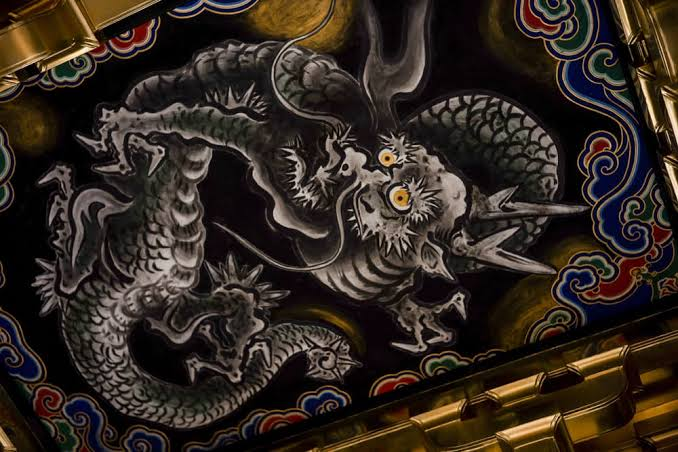
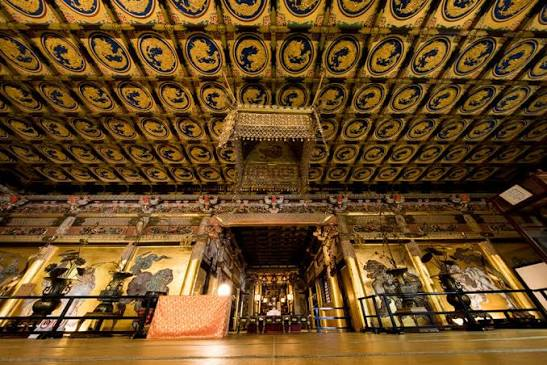
Strike a wooden clapper directly beneath the dragon painted across the ceiling of Honjido Hall, and a bell-like, ringing echo fills the room. This is the famous "Crying Dragon." The effect is a phenomenon called flutter echo: sound bounces rapidly back and forth between the curved ceiling and the hard stone floor, and the brain perceives that rapid string of reflections as one continuous tone rather than separate echoes.
What's striking is how narrow the sweet spot is — the effect only happens directly under the dragon's face. Move even slightly and the ceiling's curvature changes, killing the resonance and leaving only a dull thud. The resident monks who demonstrate it know the exact spot from long practice, which is why they never miss.
A phrase from the past
This much-quoted saying dates back to the Edo period. Kekko originally meant "splendid" or "magnificent" — the phrase essentially says, "don't casually call anything 'splendid' until you've witnessed the splendor of Nikko." Reduced to a tourism slogan today, it once carried real awe at the sheer scale of the Kan'ei-era rebuilding — an undertaking the Tokugawa shogunate staked its prestige on.
Next: the Taiyuin and the debate over Ieyasu's tomb →